Artist of the Month: Fostering South Asian creativity with Meeti Patel
Written by Vi-Linh Nguyen | January 7, 2026
Art by Meeti Patel
Animation is a medium with a long history with the capacity to tell stories in ways other media can’t. It can visualize concepts more than live action cinema can, like how Cartoon Saloon’s “The Secret of Kells,” manages to convey the history and culture of the Emerald Isle through the use of illuminated letters woven into the visual storytelling. Sony Pictures’ portrayal of Miles Morales gives viewers the story of a teenager trying to find somewhere to belong. The audience is brought along with him as he navigates that struggle in a way that wouldn’t translate as well in live action. Through it all, Miles manages to find a community for himself in his very own way. Like Miles, Meeti Patel shows us how finding your own place in the world, in that unique way, can lead you to an unexpected community.
Like many people of the LGBTQIA+ community, specifically people of color, Patel’s early life was a blur. It’s hard to remember that part of their life. The sense of self that is developed fully into adulthood is still stewing and trying to figure things out when in that childhood phase. For Patel, as a South Asian child with, “something queer happening,” as she had put it during our interview, that phase involved being fearful of their parents. If you grew up in an Asian household, this makes sense. Their cultural background did play a role in building the identity they have today though. As a third culture child and the only member of her family to be born in the United States as opposed to their siblings and parents, Patel’s position in her house was a unique one. She is the only one to be born into the Texan environment, even with the very Indian upbringing. Patel’s identity is described as an odd mix. As a transgender brown woman who is also Texan, it’s a niche mix. But it all comes together to make Meeti Patel.
The coming out process for any queer person can be a difficult one to overcome or even start. Some don’t even come out due to external circumstances, and it’s a continuous and repetitive process. But coming out can bring a community to the,” you” that was meant to be there. For Patel, it was a snapchat story freshman year of high school, to her older sister that had moved to Chicago. The distance had helped the coming out process. Even if the sibling relationship is close, that slim chance of being shunned can still be terrifying for many. Thankfully, Patel’s oldest sister, who they first came out to, took it well. From a personal standpoint, having someone to tell can feel freeing and bring that same sense of community people seek out day to day, even if that community is still small.
One must recall that Patel is an artist. The call of an artistic career is a heavy burden to bear when growing up in an Asian household. But like every artist, that calling brings the best in us. For Patel, there was no single moment that signaled that calling, more like several small moments that built up. She watched cartoons a lot growing up to the point where their parents would nickname her Cartoon, as she recounted. When her childhood self never had a satisfying answer to the adult question, what they wanted to do when she grew up, the discovery of artistic jobs was the El Dorado of potential careers. There could in fact be something to strive for. Social media helped that push too, knowing the fact that Patel wanted to pursue the arts in some way for a long time. All these professionals posting their art online for the world to see, made them realize she could do that too. All these factors lead them to pursue the Arts Technology and Communication degree offered at the University of Dallas.
Art by Meeti Patel
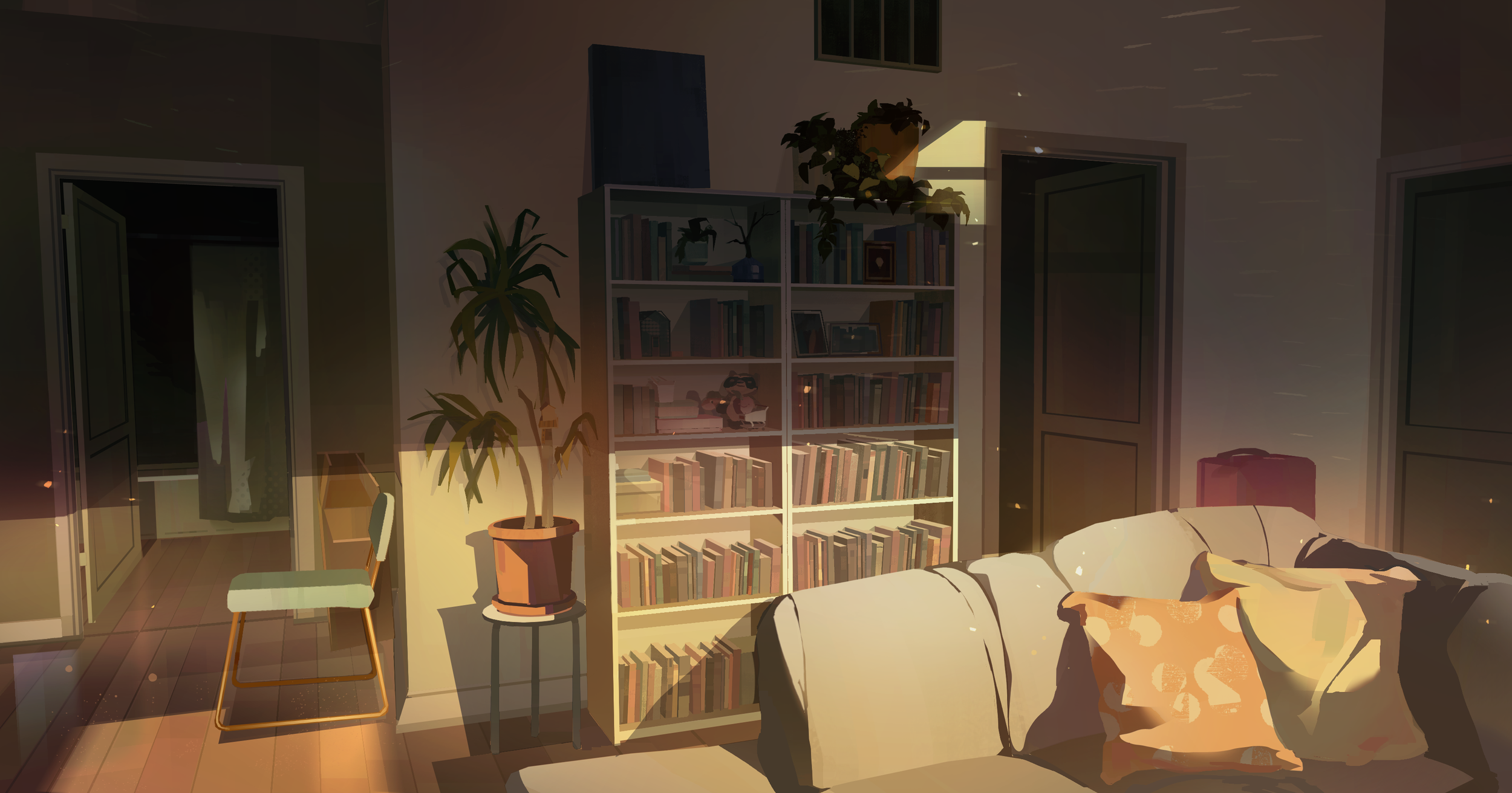
With all the different facets of the animation pipeline, visual development and background art was how Patel found her footing. Everyone who pursues animation tends to start with character art. Patel did too. They hated it. She found visual development on Twitter and it clicked. It’s hard to define visual development. There was a time Patel’s artistic focus was mostly abstract work. From the sound of how our talk went, visual development helped the muses focus Patel’s artistic talents. If Patel’s portfolio of works online is anything to go by, clearly that paid off.
Inspiration for an artist comes from many places. It can be movies, shows, or writings just to name a few. But when Patel makes comics, that inspiration has often come from other pieces of writing and other comics. Zoe Thorogood’s acclaimed graphic novel It’s Lonely at the Centre of the Earth is a long standing inspiration. According to Image Comic’s listing of the graphic novel, It’s Lonely at the Centre of the Earth talks about the author herself in an autobiographical, vividly abstract style. The vulnerability of this piece is a clear inspiration for how Patel approaches their own works. She pours every part of her soul into each work.
Because backgrounds tend to be the last choice of specialty for a young animation student, Patel’s insight into the expressiveness of scenery provides a new perspective. As she says, backgrounds and character art have the same skillset after all. It’s the same kind of storytelling but in different ways. Instead of asking who this character is, the artist asks questions like who lived here? Who touched these things in the background? These questions help consider how a space can feel alive, beyond the technical know how like shape language for example.
First and foremost though, whether working with backgrounds or characters, every art piece in a production pipeline comes back to a style guide. Style guides define the universe of an animated property, whether that is a short film, feature or TVseries. They can be as specific as telling the artists what type of line to use. Are they S lines or C lines? This ensures stylistic consistency. Characters have to look like they belong in the world created. One of the short films Patel had the chance to work on, had her create a Thailand inspired set for example. So Patel doesn’t think of the animation pipeline’s subsets as character versus background art. It’s more general. What is the style being used? If a budding animation student happens to be a reader here, this is sound advice. As someone who went through art school and became familiarized with the animation pipeline and industry practices. I can concur with it.
Two of Patel’s notable works are some of their most vulnerable too, which has an admirable boldness to showcase such raw emotion. First there’s, My Radical Personality, it talks about the effects of conformity and the never-ending cycle of it through the lens of technology. The cycle is broken the same way a viewer changes the channel, because the tv in the metaphor of the comic is the reader. How to break free from dated phobias and values is making sure you don’t have useless channels cluttering up the “TV”, i.e. you the reader. The camera that holds the memories that define the “you” in the comic (in the narrative it’s one of two Meetis), is also a cool reference to an old belief about cameras. People once believed that cameras could capture souls, and the technology metaphor used here seems to harken to that old belief. This could extend to how cyclical human belief can be, whether it’s phobias or folk tales.
Art by Meeti Patel
Second is Unwind. Unwind speaks of the politicization and objectification of trans bodies, from Patel’s perspective as a trans woman. A cisgender woman cannot speak for her, but the message is vivid from a personal understanding of the comic. When part of a marginalized group, with an identity that intersects to be a minority in that marginalized group, you’re given a unique perspective in how those in power can affect you. The subtle color work incorporating the scheme of the trans pride flag is a poignant visual tie into the poem of the comic. Those Jack Kirby bubbles common in news printing is a vivid call to old physical media, almost like a subtext that tells its readers and viewers that this infantilization of transgender bodies has been happening for longer than what the masses may assume. It’s an emotional piece condensed into a poem and a slowly unwinding portrait.
The themes are dense and can be hard to describe so why choose the comic book medium? Patel has said that they have two friends that are comic book artists and she saw them make so many comics. That passion influenced her, alongside the fact that the medium encapsulates what swarmed inside their head. There are concepts that are hard to translate into one single thing, as they described. My Radical Personality could theoretically be a single piece instead of a comic but without words, the message wouldn’t convey, as Patel explained, so comics makes logical sense to convey what needed to be said.
Would they revisit the themes of Unwind or My Radical Personality in a new medium? For some people’s personal experience reading comics, me for example, reading can tie into picturing the comic in motion. This kind of experience helps convey the possibility of seeing a comic animated. Patel has said, maybe not now, but most of their works revolve around similar messages to begin with, so the chance is never zero.
Patel’s creative space for South Asian artists, Roti Blanket, was always meant to be a place for South Asian Artists to hang out online. The fact that this came up in an interview was surprising to her. Roti Blanket started back in Patel’s freshmen, maybe sophomore year of high school. They would interview industry professionals in animation and this helped give them the skills needed to cold message more of these big names across social media. Roti Blanket was meant to be a place Patel could find people their age that fell into similar artistic interests. The Roti Blanket group evolved into a surprising professional showcase of all ages.
But Roti Blanket isn’t a guild. Members can get too nervous when a space feels too professional. Wanting to measure up is daunting. Roti Blanket is, and has always been, a casual group after all. For the true professional networking experience, animators and artists in the industry go to guilds. One of Roti Blanket’s members actually started his own guild for South Asian creatives known as SAVA, South Asians in Visual Arts. Because of the still-existing views of artistic careers in many Asian communities, these kinds of professional and casual spaces alike are paramount to the survival of individual artists, so they can showcase and build networks needed to continue their work in this topsy-turvy industry.
Patel demonstrates the drive of an artist that no matter the inner demons that haunt their mind, she finds a way to enjoy life despite said demons. That way-finding can help find a support system, since we’re social creatures after all. No matter the hardships faced, the mental hurdles can be made into art, and art can bring community. Not everyone can do that in a way that translates well to the masses. Patel does it well by showing her viewers that, despite everything in a society that treats art like a luxury item instead of a joy communities deserve, we can cherish each moment, and there’s beauty in each of them.