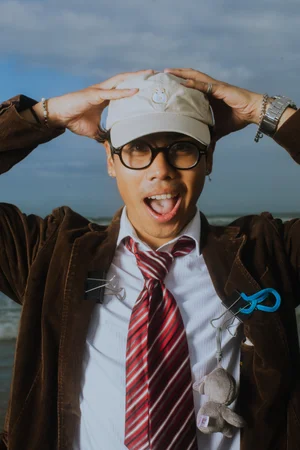
Rich Brian Brings a New Era to The Concourse Project in Austin
Written by Lorenzo Dela Cruz | March 17, 2026
Photos by Lorenzo Dela Cruz
In the hours before doors opened at The Concourse Project, fans scrolling through Instagram might have caught a pre-show ritual on Rich Brian’s story. A tray from Terry Black's Barbecue filled the frame. Brisket sliced thick, a coiled sausage, mac and cheese spread across butcher paper. By the middle of the show that night, the barbecue would unexpectedly become part of the performance.
Brian paused midway through a verse, laughed, and shook his head before restarting the song.
“The BBQ’s getting to me,” he admitted.
The venue itself added another layer to that atmosphere. The Concourse Project is known primarily as one of Austin’s major electronic music spaces, a warehouse venue designed for DJs, massive sound systems, and late-night dance floors rather than rap concerts. Early in the set Brian looked out across the room and laughed.
“I’ve never performed in a venue like this before,” he said. “I feel like a DJ.”
Yet the environment suited him. The venue’s wide open floor and minimal barriers between performer and audience gave the night an intimacy that might have been harder to achieve in a traditional theater setting.
When Brian first broke through in 2016, the narrative surrounding him centered on improbability. A teenager from Jakarta had absorbed American rap through the internet and suddenly appeared within its cultural orbit. His breakout single, “Dat $tick,” spread rapidly online for its blunt humor and minimalist trap production, turning the then-teenager into a viral curiosity almost overnight. Follow-up tracks like, “Who That Be,” and “Glow Like Dat,” expanded that early momentum, revealing glimpses of the melodic introspection that would later shape his sound. At the time, however, much of the conversation around Brian focused less on the music itself and more on the shock of his emergence.
Nearly a decade later, that framework feels increasingly distant.
Photos by Lorenzo Dela Cruz
The set in Austin moved fluidly between those early songs and the quieter, more reflective material that has come to define Brian’s later work. With the release of his latest album earlier this year, Brian’s musical trajectory has become even clearer. Where the early records leaned heavily on the directness of trap rap, the new material reveals a noticeably expanded palette. The songs draw more freely from alternative R&B, indie rock textures, and singer-songwriter sensibilities, allowing Brian to move between rapping and melodic vocals with far greater range.
That evolution was evident throughout the performance. The newer songs felt less built around punchlines and more around mood and storytelling, often unfolding with softer instrumentation and a slower emotional tempo. Brian’s delivery has grown more flexible as well, shifting between conversational rap cadences and understated singing that emphasizes vulnerability over bravado. The effect is a catalog that feels increasingly cohesive, one where the viral aggression of his early work coexists with the introspective songwriting that now defines his artistic voice.
“This is my Tiny Desk,” he said as he prepared an acoustic section of the set.
In a venue built for booming electronic basslines, the acoustic moment landed with surprising clarity. Phone flashlights rose across the crowd during “Drive Safe,” forming a constellation of white light above the floor. Brian stopped halfway through the song as the audience sang the chorus louder than he did and restarted it simply to hear the moment again.
The gesture captured something essential about Brian’s artistic maturation. The early years of his career relied heavily on spectacle and the novelty of his origin story. The artist onstage now appears far more invested in intimacy and reflection.
That sensibility carried into a brief story about Jakarta, the city where he grew up. Brian explained that music had not originally been his ambition.
Photos by Lorenzo Dela Cruz
“I wanted to move to the U.S. and be a film director,” he told the audience. “Then the music happened.”
He spoke about the pandemic years when visa complications prevented him from returning home for nearly three years. Life continued in Jakarta while he was away. His brother got married. Nieces and nephews were born.
“My brother got married,” Brian said as the crowd cheered.
“That’s not hype,” he replied with a smile. “I wasn’t there.”
Brian’s trajectory is inseparable from the broader cultural movement that helped sustain it. As one of the earliest breakout artists associated with 88rising, he emerged during a moment when Asian musicians were beginning to claim greater visibility within Western hip hop and pop. What began as a niche collective has since developed into a global cultural platform.
That shift appeared quietly in the room itself. At one point Brian asked the crowd to make noise if they were Asian, then Indonesian, Vietnamese, and Chinese. Each prompt drew cheers from different corners of the venue. The exchange was brief but revealing. The audience reflected a generation of listeners for whom the presence of Asian artists in these spaces no longer requires explanation.
Late in the set Brian noticed a fan near the barricade asking him to sign an arm destined to become a tattoo. Brian laughed and asked if the fan also had Joji’s signature inked somewhere, a small nod to another artist whose early internet origins once paralleled his own.
He signed the arm anyway.
Watching Rich Brian perform revealed how thoroughly he had outgrown the narrative that once defined him. The improbable origin story of a Jakarta teenager entering American rap culture had faded into the background. In its place stood a musician whose work increasingly prioritized vulnerability, reflection, and the emotional complexity of life lived between cultures.