Austin Psych Fest 2026 Recap and Review
Written by Lorenzo dela Cruz | June 2, 2026
Austin has always had a complicated relationship with time.
The city sells itself on reinvention, but its most enduring cultural institutions are often the ones that understand how to live in multiple eras at once. Austin Psych Fest has become one of those institutions. Over three days at The Far Out Lounge, the festival once again demonstrated why it remains one of the most compelling gatherings in American independent music, not because it chases the future, but because it allows the past and present to occupy the same space.
This year's lineup felt particularly attuned to that tension. Headlined by The Flaming Lips, The Black Angels, and Thee Sacred Souls, the festival moved fluidly between its psychedelic rock origins, its contemporary mutations, and the genres that have quietly inherited its DNA.
Photos by Lorenzo dela Cruz
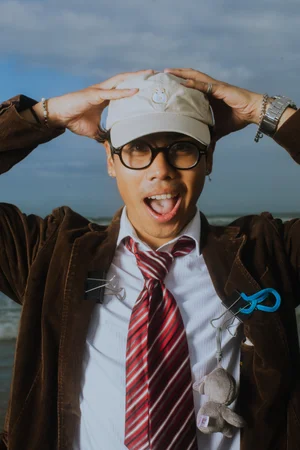
The stereotype of psychedelic rock audiences as aging has become increasingly outdated. Throughout the weekend, younger attendees filled the grounds in football jerseys, oversized headphones slung around their necks, digital cameras clipped to belt loops, and band shirts from groups that didn't exist five years ago. They arrived for legacy acts, but just as often for artists whose relationship to psychedelia is indirect, filtered through shoegaze, indie rock, post-punk, and internet subcultures.
On Friday, The Flaming Lips closed the evening in a way only The Flaming Lips can. For decades, Wayne Coyne and company have occupied a unique place within psychedelic music, expanding the genre's emotional vocabulary. Their version of psychedelia is maximalist and deeply human. Equal parts existential dread and childlike wonder.
Where many psych acts seek transcendence through repetition or distortion, The Flaming Lips find it through spectacle and vulnerability. Giant inflatables, confetti storms, cosmic imagery, and singalongs transformed the festival grounds into something resembling a collective dream. Watching thousands of people lose themselves in songs that oscillate between joy and melancholy felt like a reminder that psychedelia has never solely been about sonic experimentation; it has also been about expanding emotional perception. Earlier in the evening, bands like DIIV and Glare demonstrated how younger artists continue to reinterpret those same impulses. Their music was less outwardly colorful but equally immersive, creating dense environments where melody and atmosphere became inseparable.
On Saturday, the Black Angels' performance carried a different kind of weight. Celebrating two decades of Passover, their set served as a direct line back to Austin's modern psych-rock renaissance. The band's music remains grounded in drone, repetition, and tension, emphasizing the hypnotic qualities that have defined psychedelic rock since its earliest incarnations. Songs written twenty years ago still felt urgent because they operate on principles that never really age. Their performance reminded the audience that psychedelia can be confrontational as much as it is escapist.
Ty Segall complemented that energy perfectly. If The Black Angels represented discipline, Segall represented chaos. His set pushed against genre boundaries entirely, pulling from garage rock, punk, noise, and psychedelia with equal enthusiasm. It underscored one of the festival's central arguments: that psychedelia isn't a genre so much as a tendency, a willingness to mutate, distort, and dismantle musical conventions.
By Sunday, the festival had opened itself even wider.
Photos by Lorenzo dela Cruz
Thee Sacred Souls closed the weekend with one of the most quietly radical performances of the festival. On paper, a modern soul group might seem like an unusual choice to headline Austin Psych Fest. In practice, they embodied one of the festival's most compelling ideas. Their music isn't psychedelic because of guitar pedals or extended jams, it's psychedelic because of its capacity to alter emotional space. Thee Sacred Souls' songs moved through heartbreak, longing, tenderness, and memory with a patience that felt increasingly rare. Their performance demonstrated that transportive music doesn't always arrive through volume or distortion. Sometimes it arrives through restraint.
That same spirit carried through sets from LA LOM, Trish Toledo, and Como Las Movies, whose performances expanded the festival's understanding of what psychedelic music can encompass. Soul, Latin music, oldies, cumbia, and cinematic songwriting all became part of the conversation. Rather than feeling like departures from the festival's mission, they felt like natural extensions of it. In many ways, Sunday's lineup provided the clearest picture of where Austin Psych Fest is headed. Not toward a narrower definition of psychedelia, but a broader one.
Over the course of the weekend, each headliner offered a different answer to the same question. Three entirely different approaches. Three entirely different sounds. Yet all arrived at the same destination: music capable of shifting perception, however briefly.
Photos by Lorenzo dela Cruz
That may be Austin Psych Fest's greatest strength, it understands that psychedelia was never meant to be a fixed genre. The moment it becomes fixed, it stops being psychedelic. Instead, the festival continues to treat it as a living idea, one that can exist in fuzzed-out guitars, soul ballads, shoegaze textures, Latin rhythms, noise rock outbursts, and everything in between.
As the weekend came to a close, that felt like the festival's most significant achievement. Not simply honoring Austin's psychedelic legacy, but demonstrating how that legacy continues to evolve through younger artists, new audiences, and increasingly fluid definitions of genre itself.
Keep up with Austin Psych Fest and more:
Instagram: @levitation