aespa Keep Their Edge as Their World Gets Bigger in Dallas
Written By Lorenzo dela Cruz | October 26, 2026

Photo Credit: Darah Hubbard
aespa did not ease Dallas into SYNK : COMPLæXITY. The show opened with a massive introduction stretching across the screens of American Airlines Center before Karina, Giselle and Ningning emerged and launched into “LEMONADE.” Everything was immediately oversized: the screens, the bass, the graphics and an arena full of MYs screaming back at them.
It was the kind of production that made sense for where aespa are now. Three years earlier, the group’s Dallas-area stop on SYNK : HYPER LINE took place at The Pavilion at Toyota Music Factory in Irving, where the show sold out. In 2026, they returned to North Texas at American Airlines Center. The difference in scale was hard to miss, but what was more interesting was how little aespa themselves seemed to have changed to reach it.
aespa’s move deeper into the Western market has not required them to abandon the strange sound and aesthetic that made them distinct in K-pop. If anything, they have continued to lean further into it. Their music is still sharp, synthetic and sometimes intentionally abrasive, moving between electronic pop, R&B, hip-hop and hyperpop without always worrying about making the transitions smooth. Their visual world remains just as recognizable through glitches, metallic textures, videogame imagery and technology pushed slightly past the point of comfort.
That identity filled an arena in Dallas, even with one major piece missing.
Hours before the show, SM Entertainment announced that Winter had been diagnosed with shingles after experiencing health issues around aespa’s Miami stop. She had performed in Miami despite feeling unwell, but after her condition did not improve, doctors recommended that she rest instead of continuing with the Dallas performance. Winter sat out the Dallas stop with shingles, and in the Texas heat, the irony was hard to miss.
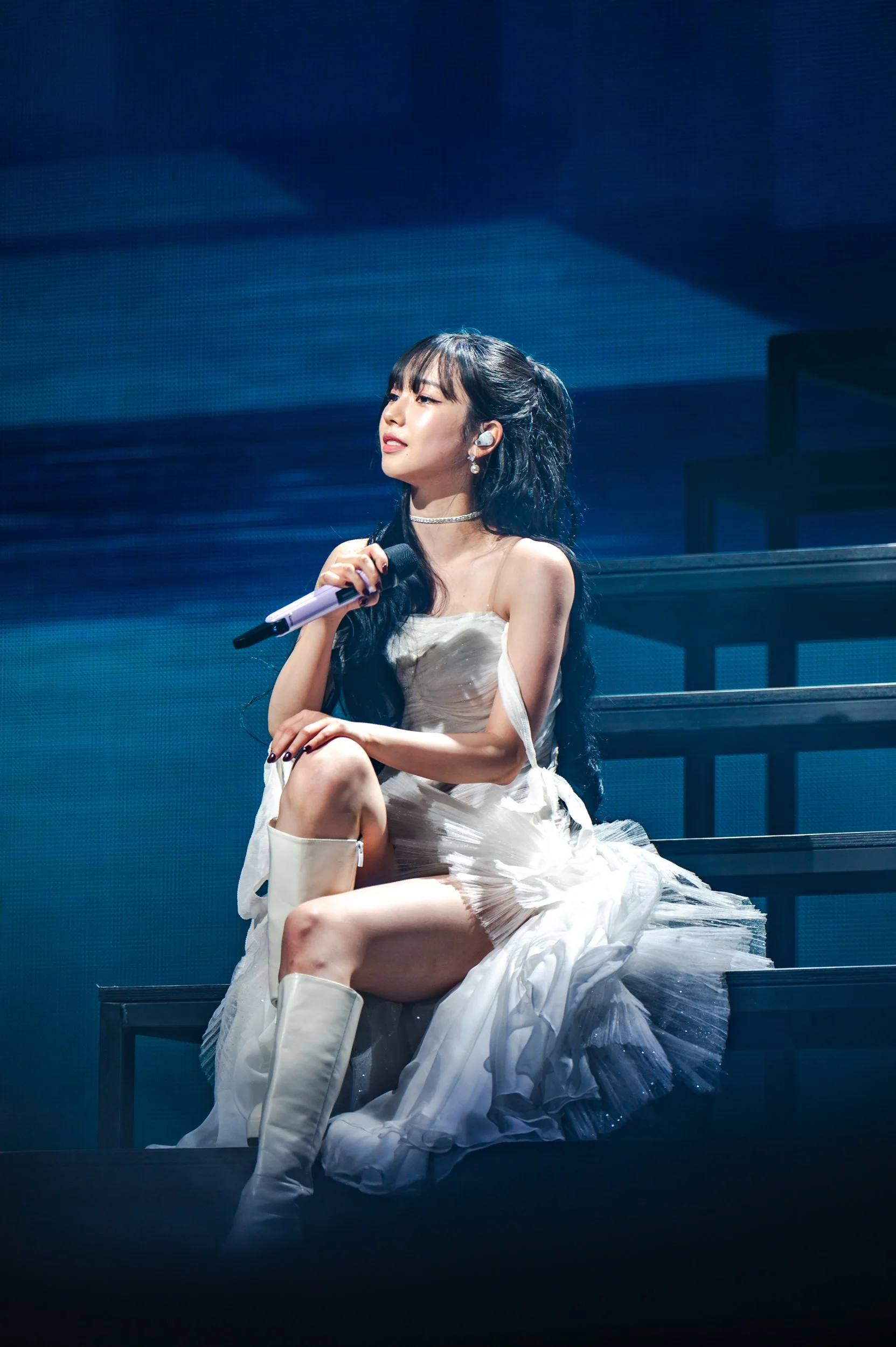
Photo Credit: Darah Hubbard
Her absence changed the show in obvious ways. Winter’s solo “Saddle Up” and her duet with Karina, “Serenade,” were removed, shortening a section normally built around giving each member their own moment. Still, aespa did not spend the night trying to pretend nothing had happened. During one of the speaking sections, Giselle called for a moment for Winter before joking that she was “resting well in peace,” quickly turning what could have been an awkward absence into one of the night’s funniest exchanges.
The three remaining members also relied on the crowd to fill some of the gaps Winter left behind. By the end of the night, Karina thanked Dallas for essentially becoming a room full of temporary Winters, recognizing fans who had spent the show singing along to her missing parts. Instead of letting Winter’s absence hang over the performance, aespa found ways to acknowledge it without letting it define the night.
The concert itself moved quickly. “LEMONADE” led directly into “Switchblade,” “Whiplash,” “Black Mamba” and “WDA (Whole Different Animal),” stacking some of aespa’s heavier songs together within the opening stretch.
“Switchblade” offered one of the clearest connections between aespa’s current music and their growing place in the Western market. The song features Ty Dolla $ign, whose vocals took over as Karina, Giselle and Ningning moved toward the front of the stage. A few months earlier, he had joined aespa in person to debut the song live during their Lollapalooza set in Chicago.
It is the type of collaboration that could have easily sounded like an attempt to make aespa more familiar to an American audience. Instead, Ty Dolla $ign sounds like the guest.
That difference says a lot about how aespa has approached their expansion outside Korea. Becky G appears on an alternate version of “LEMONADE,” but these collaborations do not feel like aespa stripping their music down for crossover potential. The artists are entering aespa’s existing world rather than aespa rebuilding that world around them.
The concert’s visuals pushed that identity even further. Huge snakelike forms moved across the screens behind the members, while glitches, flames and digital effects constantly distorted the live camera feeds. The screens were not simply there to give the back of the arena a better view. They became another part of the performance, reshaping what was happening onstage in real time.
During Karina’s “16 Bit,” the camera work leaned especially hard into the song’s videogame aesthetic. Her image was processed and framed in a way that made her look less like someone standing on an arena stage and more like a character moving through the screen itself.
That kind of production could easily become gimmicky, but it works for aespa because none of it feels randomly attached to them. K-pop is built around constant reinvention, yet aespa rarely feel like they are completely starting over with every comeback. The glitches, digital imagery and futuristic styling have followed them through different eras long enough that they have become less of a temporary concept and more of a visual language.
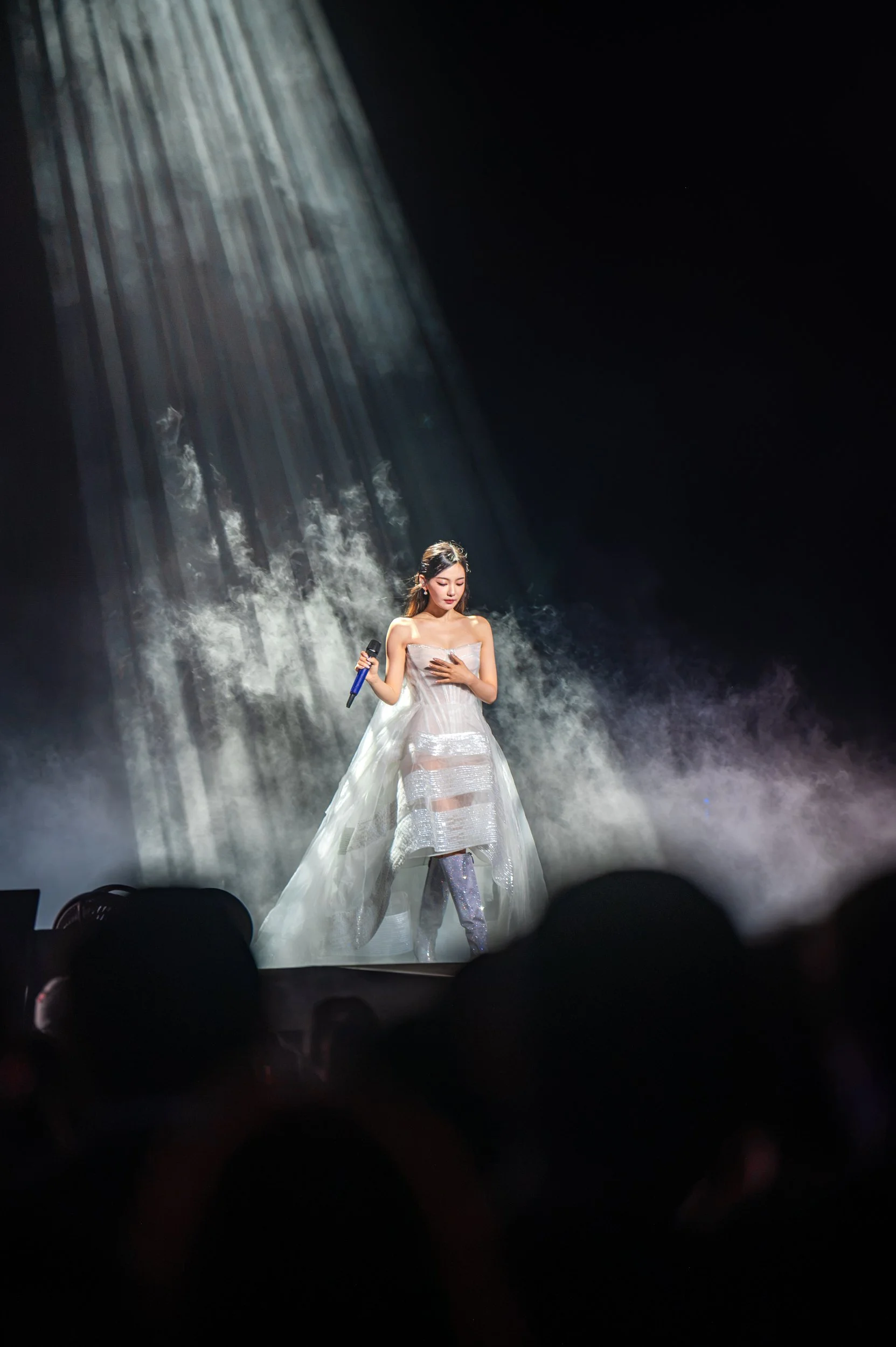
Photo Credit: Darah Hubbard
Their world just keeps getting updated.
The same idea carries into the music. The middle of COMPLæXITY loosened the boundaries of the main aespa sound with a run of unit and solo performances. Giselle and Ningning paired up for “Lollipop,” followed by Karina’s “16 Bit,” Giselle’s “BYEB4HELLO” and Ningning’s “I Love You but I Gotta Let You Go.” Winter’s missing solo and duet were especially noticeable here, but the remaining performances still gave each member room to push the show in a different direction.
Giselle’s solo leaned further into hyperpop, with a dance break that matched the track’s restless production. Later, “Armageddon” arrived in a heavier, rock-inspired arrangement before the show moved back toward its electronic core. At times, COMPLæXITY felt like aespa were opening different folders on a computer just to see what was inside.
Not every experiment worked equally well. The rock arrangement felt somewhat disconnected from the rest of the show, and parts of the middle felt more interested in showing how many different things aespa could do than letting any one idea settle. Still, that restlessness is part of what has made the group interesting. aespa can jump between sounds without completely losing the identity holding them together.
Songs like “Whiplash,” “Supernova” and “Armageddon” do not sound the same, but it is difficult to imagine them belonging to anyone else. There is a metallic edge that runs through much of aespa’s music: heavy bass, abrupt switches, unusual song structures and production that is willing to sound harsh or even ugly for a few seconds before snapping back into something polished.
That combination has given aespa one of the more recognizable sounds and aesthetics of their generation in K-pop. Their music does not always prioritize being immediately comfortable, and their visuals rarely aim for restraint. Instead of becoming limitations as aespa moved into larger markets, those qualities have increasingly become their advantage.
That is what makes their growth in the United States worth paying attention to.
aespa’s relationship with the American market has been building for years, from their Coachella appearance in 2022 and first North American tour in 2023 to increasingly larger venues, festival stages and Western collaborations. By 2026, they had made their Lollapalooza debut in Chicago before heading into another North American arena run.
The easy version of that story would be to say aespa figured out how to appeal to America. Dallas suggested something more interesting: American audiences have increasingly figured out aespa.
The group has certainly adapted as its reach has grown. English-language music, festival appearances and collaborations with artists like Ty Dolla $ign and Becky G make that obvious. But the core of aespa has not been replaced in the process. Their music remains heavily electronic, their visuals remain excessive and their songs can still take a strange turn when a simpler one would probably be easier.
Even LEMONADE, an album arriving as aespa’s presence in the U.S. continues to grow, doubles down on much of the electronic production associated with the group rather than abandoning it.
That makes the difference between their 2023 and 2026 Dallas stops feel larger than a simple venue upgrade. The Pavilion at Toyota Music Factory already showed that aespa had an audience here. American Airlines Center showed what happened when that audience became large enough for aespa’s world to operate at arena scale.
For all of the technology surrounding COMPLæXITY, though, some of the night’s best moments had almost nothing to do with the screens.
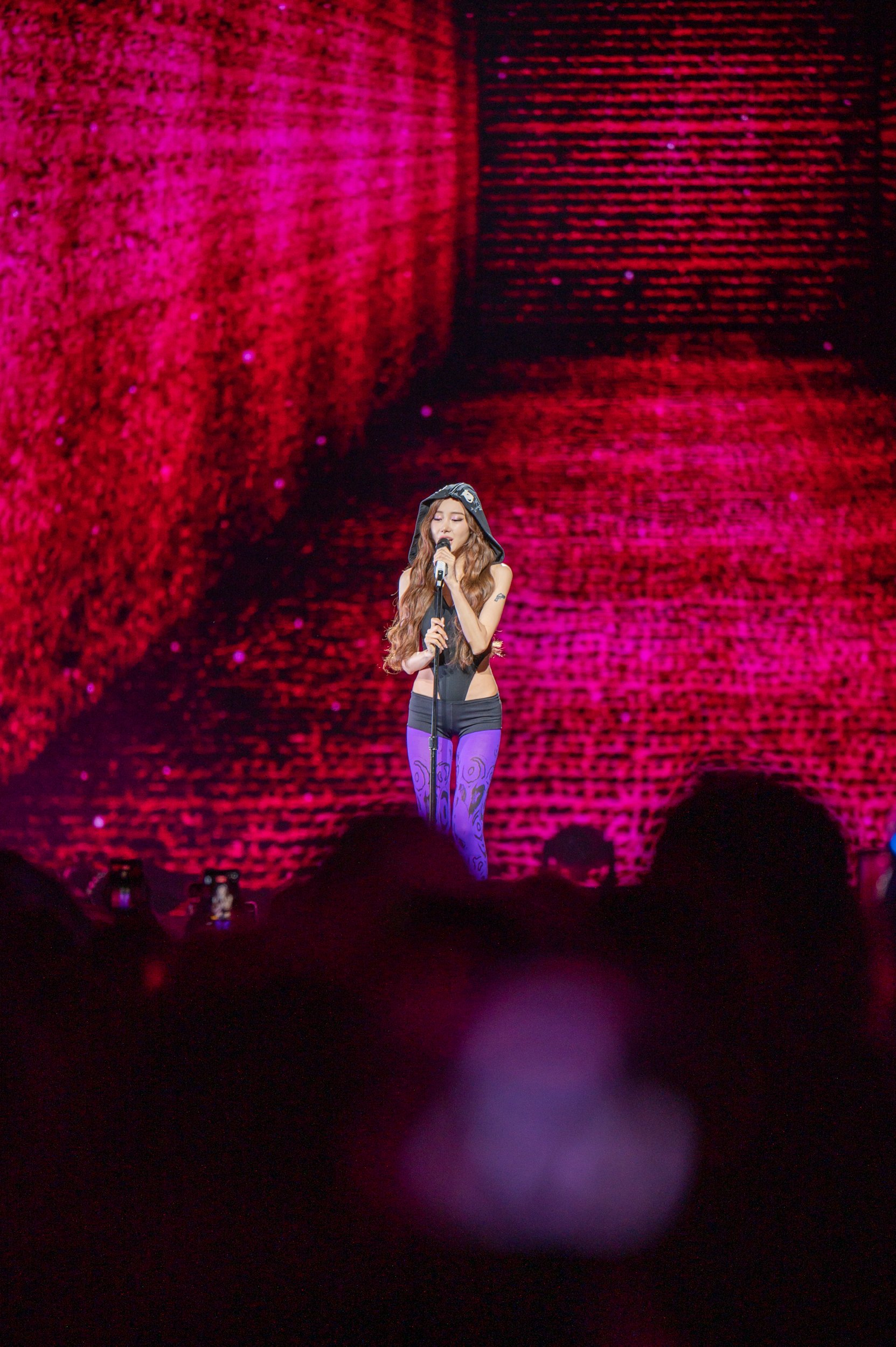
Photo Credit: Darah Hubbard
During the encore, the futuristic aespa universe briefly gave way to Texas, with a cowboy hat eventually making its way onto Giselle. She also told the crowd she had eaten brisket for breakfast and enthusiastically reported that it was “sooo good,” earning exactly the reaction that kind of statement is supposed to get from a Texas audience.
Those moments gave the concert some needed looseness. aespa’s performance style is incredibly controlled: choreography has to hit at the right moment, cameras have to follow it, VCRs move the concert through different sections and the graphics constantly reinforce the larger concept. Even the glitches are carefully designed glitches.
Watching the members joke about Winter, put on cowboy hats and talk about brisket allowed some personality to slip through all of that precision. The three members were carrying a show designed for four people, but the night rarely felt defined by what was missing.
Near the end, they thanked Dallas for the energy the crowd had given them in Winter’s absence. Karina described performing with so many “Winters” in the audience as something she would remember, while Giselle’s brisket story and the cowboy hats kept the final stretch from becoming overly sentimental.
Then came “‘Til We Die,” along with the declaration that their sounds would be with the audience until the end.
Corny? A little.
But aespa had already made the more convincing argument over the previous two hours.
The biggest takeaway from Dallas was not simply that aespa can put on an enormous K-pop production. At this level, giant screens, complicated staging and precise choreography are expected. What stood out was how naturally the qualities that make aespa strange survived the jump in scale.
Their growth in the West has brought bigger venues, major festival appearances and collaborations with recognizable American artists, but none of those things have required aespa to become a more generic version of themselves. Their music remains unpredictable, their visuals remain excessive and their songs can still move in directions that do not always seem interested in making things easy for the listener.
Those qualities are no longer obstacles standing between aespa and a larger Western audience. They are part of why that audience keeps getting larger.
Three years ago, aespa played a sold-out show at The Pavilion at Toyota Music Factory. Now they are performing at American Airlines Center. At this point, the interesting question is no longer whether there is a Western audience for aespa.
There clearly is, and aespa did not have to meet that audience halfway to find it.
The audience came to them.